Kang Junseok
- Towards Purification
Nov. 13, 2026 - Dec. 26, 2026
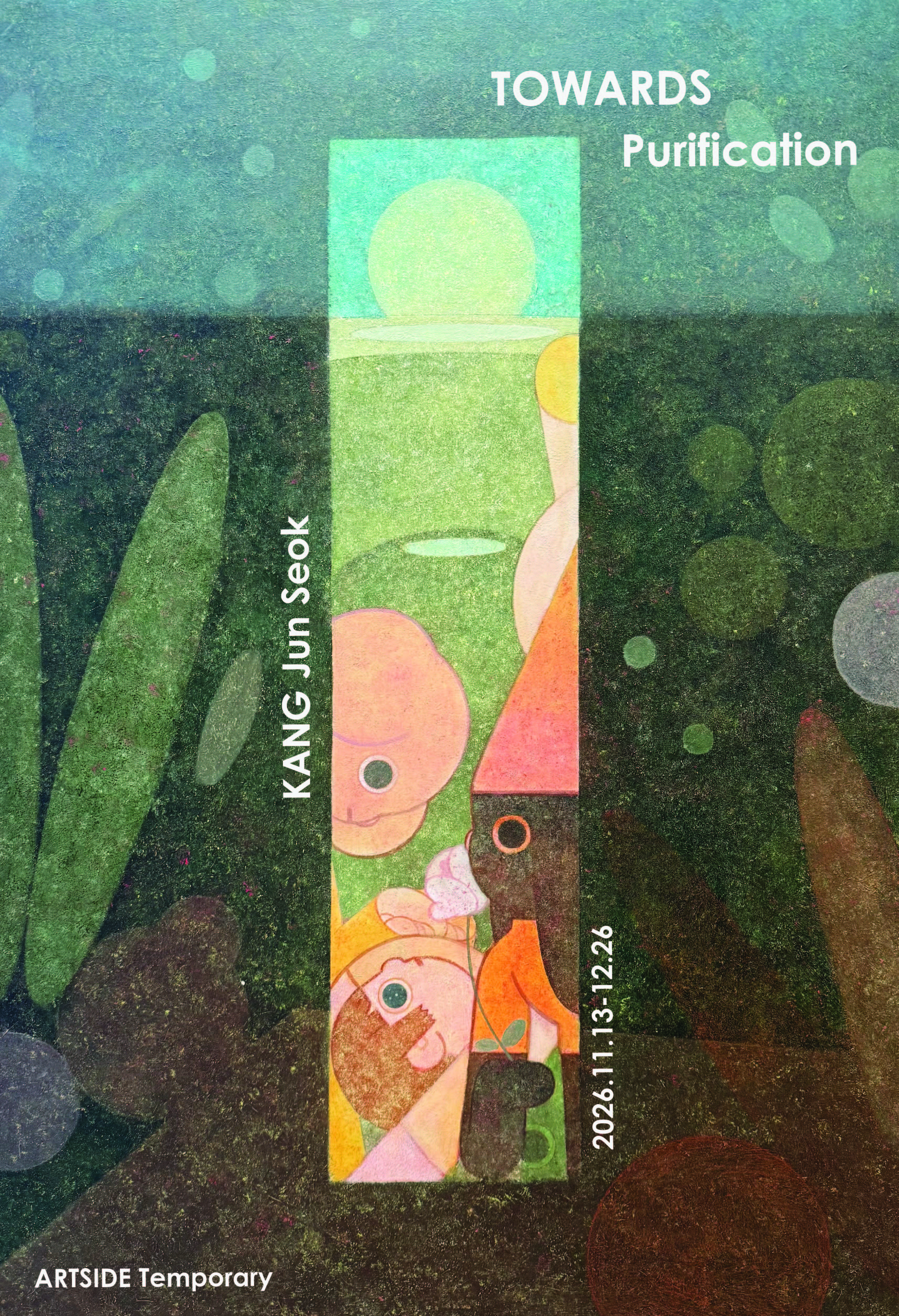
본 전시는 어딘가 무표정한 얼굴을 한 인물들을 조금씩 몰래 지켜보는 구도로 시작된다. 여기에 등장하는 인물들은 작가의 다른 작품이 그러했듯 어디론가 향하는 구도로 그려져 있는데, 흥미로운 지점은 관람객이 숲의 한 틈을 통해 이들의 움직임을 엿보게 된다는 점이다. 지켜보는 자리에 서는 순간 관람객은 이들의 여정에 허락 없이 끼어든 은밀한 목격자가 되고, 그들이 향하는 곳은 그만큼 더 비밀스러워진다. 힘차게 도약하는 인물들을 따라, 때로는 조용히 행진하는 그들의 걸음을 좇다 보면 우리는 마침내 〈Grand Bath〉라는 공간에 도달한다.
이 여정이 숲과 정원을 지나 욕장에 이르는 것은 우연이 아니다. 동서양을 막론하고 정원은 속세와 분리된 낙원의 형상으로 그려져 왔다. 영어의 paradise는 '담으로 둘러싼 곳'을 뜻하는 고대 페르시아어에서 비롯되었고, 중세 유럽의 닫힌 정원(hortus conclusus)과 동아시아의 무릉도원 역시 세상과 경계 지어진 평화로운 장소를 상상한 것이다. 정원에 들어선다는 것은 곧 일상의 규칙을 벗어나는 문턱을 넘는 일이다. 그리고 그 끝에 놓인 욕장은 물과 몸이 만나는 장소다. 물은 예부터 세례가 암시하듯 속세의 무언가를 씻어내리는 정화의 매개였고, 고대 로마의 공중목욕장이나 중동의 하맘, 일본의 온천처럼 옷과 함께 지위와 직함을 벗어 두는 곳이기도 했다. 신분과 나이가 다른 이들이 같은 물에 몸을 담그는 자리, 그곳은 오랫동안 세속과 분리된 동시에 서로가 가장 가까워지는 공간이었다.
전시의 제목인 정화, 곧 Purification은 이러한 장면을 하나의 단어로 압축한다. 淨化의 '淨'에는 물(氵)이 들어 있어 씻어 맑아진다는 감각이 새겨져 있고, purification은 '깨끗한 것'과 '만들다'가 합쳐진 라틴어에서 왔다. 두 말 모두 이미 깨끗한 상태에 놓여 있다기보다 깨끗해져 가는 과정을 가리킨다. 그래서 이 전시의 제목은 도달한 상태가 아니라 향해 가는 움직임을 말하고, 'Towards'라는 전치사가 그 방향을 붙든다. 이처럼 모든 것이 한데 모여 물에서 얽히고 동화되는 모습은 작가가 항상 꿈꿔왔던 이상적인 소통의 세계를 암시한다. 모든 것이 한데 얽히고 섞여 내가 타인이 되고 타인이 내가 되는, 비로소 그때 이해할 수 있는 것들에 대해 작가가 꿨던 꿈처럼 말이다.
그동안 많은 모티프를 유연하고 동적인 구도로 리듬감 있게 배열해 온 강준석 작가의 구성은 이번 대작을 통해 가장 선명하게 확장된다. 숲을 가로지르던 걸음들이 하나의 물가로 모여드는 장면에서, 개별적이던 움직임은 거대한 리듬으로 합쳐진다. 무표정한 얼굴들이 물속에서 어떤 표정으로 바뀌는지, 혹은 끝내 바뀌지 않는지는 관람객이 직접 확인할 몫이다. 숲의 틈에서 시작된 엿보기가 어느새 물가에 선 참여로 바뀌는 순간, 우리 역시 그들이 향하던 곳을 향해 한 걸음 내딛고 있을 것이다.
The exhibition begins with a composition in which we secretly watch, little by little, figures with somewhat expressionless faces. As in the artist’s other works, the figures here are depicted heading somewhere, and what is intriguing is that viewers glimpse their movements through a gap in the forest. The moment viewers take up this position of watching, they become secret witnesses who have intruded on the figures’ journey without permission, and the place the figures are headed grows all the more secretive. Following the figures as they leap forcefully, and at times march quietly, we finally arrive at a space called Grand Bath.
It is no coincidence that this journey passes through forest and garden to reach the bathing hall. East and West alike, the garden has been depicted as a paradise set apart from the mundane world. The English word “paradise” derives from an ancient Persian word meaning “a walled enclosure,” and the medieval European hortus conclusus (enclosed garden) and the East Asian Mureung Dowon (Peach Blossom Spring) likewise imagine peaceful places bounded off from the world. To step into a garden is to cross a threshold out of the rules of everyday life. And the bathing hall at its end is a place where water and body meet. As baptism suggests, water has long been a medium of purification that washes away something of the secular world, and, like the public baths of ancient Rome, the Middle Eastern hammam, and the Japanese onsen, it is also a place where one leaves status and title behind along with one’s clothes. A place where people of differing rank and age immerse themselves in the same water, it has long been both separated from the secular world and the space in which people come closest to one another.
The exhibition’s title, Purification (淨化), condenses such scenes into a single word. The character 淨 contains the water radical (氵), carrying the sensation of being washed clear, and “purification” comes from a Latin word combining “clean” and “to make.” In both languages, the word refers less to a state of already being clean than to the process of becoming clean. The title therefore speaks not of a state that has been reached but of a movement toward it, and the preposition “Towards” holds that direction in place. This image of everything gathering, entangling, and assimilating in the water hints at the ideal world of communication the artist has always dreamed of: a world where everything intermingles, where I become the other and the other becomes me, and where only then can certain things be understood, just as the artist once dreamed.
Kang Jun Seok’s compositions, in which he has rhythmically arranged many motifs in flexible, dynamic layouts, expand most vividly in this large-scale work. In the scene where steps that crossed the forest converge on a single waterside, individual movements merge into one grand rhythm. Whether the expressionless faces change into some expression in the water, or never change at all, is left for viewers to see for themselves. At the moment the peeping that began in a gap in the forest turns into participation at the water’s edge, we too will already be taking a step toward where they were headed.